
How to Get Rid of Tonsil Stones (For Good)

Last Updated Mar 11, 2026
If you just read that and thought "that's me," keep reading. Because the reason nothing has worked isn't that you're doing something wrong. It's that every solution you've been given treats the symptom, not the cause.
First: this is not your fault
Let's get this out of the way. You probably have better oral hygiene than most people you know. You brush, you floss, you gargle. You've probably researched tonsil stones more than your doctor has. And yet they keep coming back.
That's not a failure of effort. That's a failure of approach.
The people telling you to "just gargle more" or "try a water pick" are giving you advice for a problem they don't actually understand. Even the ENTs who dismiss it as "just psychological," they're not wrong that it won't kill you. They're wrong that you should just live with it.
Sound familiar? You're not being dramatic. You're not overthinking it. This is a real problem and it has a real explanation.
Here's what's actually happening in your mouth
Most people (and even some doctors) will tell you tonsil stones are "just food stuck in your throat." That sounds logical. But it's wrong, and believing it is the reason nothing you've tried has worked.
Yes, food particles play a role. But food particles pass through everyone's mouth. Not everyone gets tonsil stones. The difference isn't food. It's which bacteria are living in your tonsil crypts.
Your tonsils have small pockets called crypts. Everyone has them. In a healthy mouth, those crypts are lined with a balanced mix of bacteria: some good, some neutral, some bad, all keeping each other in check.
At some point, that balance tipped. Sulfur-producing bacteria took over your tonsil crypts and started building colonies. These bacteria feed on dead cells and food particles, then produce volatile sulfur compounds (VSCs). Those compounds harden into the white or yellow chunks you know as tonsil stones. They're also why they smell like, as one person put it, "rancid gross death."
If tonsil stones were "just food," then better oral hygiene would fix them. You already know it doesn't. That's because you're dealing with a bacterial colony, not leftover dinner.
If better hygiene could fix tonsil stones, yours would already be gone.
This is why your oral hygiene doesn't matter. You could brush five times a day. The bacteria living deep inside your tonsil crypts don't care. Your toothbrush can't reach them. Your mouthwash can't reach them. Your water pick blasts the surface but the colonies are buried inside the crypts, rebuilding overnight.
Why everything you've tried makes it worse
Mouthwash is the biggest offender. It kills bacteria in your mouth, all of them, good and bad. Sounds helpful until you realize the good bacteria were the only thing slowing the bad ones down. Wipe the slate clean and the aggressive, sulfur-producing bacteria colonize back faster than the good ones. You end up worse than before.
Salt water gargling is gentler, but it can't penetrate deep into tonsil crypts. You're rinsing the hallway while the problem is behind a locked door.
Q-tips and picking remove the stones you can see. But there are more forming behind the ones you just pulled out. And the more you poke, the more you irritate the tissue, which creates more crevices for bacteria to hide in. One person described it perfectly:
Water picks give temporary relief but high pressure can push debris deeper into crypts. And the bacteria that actually cause the stones? They're in biofilm, a protective layer that water pressure alone can't break through.
Even surgery doesn't always work
You've probably thought about getting your tonsils removed. Maybe you've already asked your doctor about it. Here's what most ENTs won't tell you:
Tonsil stones aren't caused by your tonsils. They're caused by the bacteria living in your tonsils. Remove the tonsils and those bacteria are still in your mouth: on your tongue, gums, and throat lining. Tonsil tissue can partially regrow. New crypts form. The bacteria colonize them. And the stones come back.
That's a $3,000-$10,000 surgery with 2-3 weeks of brutal recovery, a 3-5% risk of serious bleeding, and no guarantee the stones won't return. Before you go down that road, there's something worth trying first.
What if you could stop them from forming in the first place?
What actually works: change the bacteria
Remember the garden analogy? If weeds have taken over, you don't just keep pulling them. You plant dense ground cover: healthy plants that fill every inch of soil so the weeds can't grow back.
That's the idea behind oral probiotics: beneficial bacteria, delivered directly to your mouth and throat, that colonize the same spaces the bad bacteria are living in.
When you flood your tonsil crypts with the right strains of good bacteria, two things happen:
First, they physically crowd out the sulfur-producing ones. There's only so much space in your tonsil crypts. Fill that space with good bacteria and the bad ones lose their foothold.
Second, they reduce volatile sulfur compounds, the molecules that form stones and create that smell. Less VSCs means fewer stones and fresher breath.
You're not removing stones after they form. You're changing the environment so they can't form. That's the difference between managing a problem and solving it.
But here's the thing: not just any probiotic works. Gut probiotics (the kind you find at the pharmacy) are designed to survive stomach acid and colonize your intestines. They pass through your mouth without sticking around. What you need are specific strains, proven to colonize oral tissue, delivered in a form that keeps them in your mouth long enough to work.
The research behind it
This approach isn't new. Researchers have been studying it for over a decade:

A 2013 study in the International Journal of Oral Science found that Lactobacillus strains significantly reduce volatile sulfur compounds, the exact molecules that cause tonsil stones and that awful smell.
A 2020 study in Nutrients confirmed that oral probiotics successfully colonize the mouth and throat when delivered as a chewable tablet before bed.
And research published in Microorganisms mapped the bacterial communities inside tonsil crypts, confirming that sulfur-producing bacteria are the root cause of stone formation.
That's why we made Oral Harmony

Oral Harmony is a chewable tablet with 4 clinically studied probiotic strains and 3.5 billion CFUs, specifically chosen from the research above. You chew one before bed. It tastes like a mild mint. While you sleep, the probiotics coat your mouth, throat, and tonsil crypts with beneficial bacteria.
No Q-tips. No gagging. No daily mirror sessions. Just one tablet, 30 seconds, and the probiotics do the rest while you sleep.
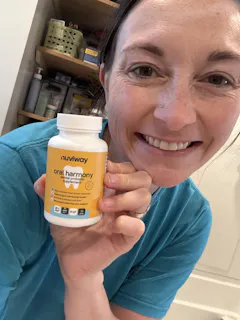
Over 1,000 people have already made the switch. Here's what they're saying:
What to expect
You're shifting an entire bacterial ecosystem. It doesn't happen overnight. But most people notice changes faster than they expect:
The comparison nobody shows you
 Oral Harmony
"I've tried everything." You haven't tried this.
We hear that a lot. And it's true: you've tried everything that treats the symptom. Salt water. Mouthwash. Q-tips. Water picks. Tongue scrapers. Diet changes. Maybe even antibiotics. None of them worked because none of them change the bacterial environment inside your tonsil crypts.
You haven't tried the one approach that actually addresses why the stones keep forming. Not because you didn't look hard enough. Because nobody told you about it.
The Q-tips will still be there if you need them. The ENT's office will still be there. The surgery will always be an option. But before any of that, before the pain, the cost, the recovery, try this first. Because if it works, you'll wish you'd found it years ago.

RISK-FREE TRIAL
